
The market has already caught on to what every SaaS vendor knows: AI agents don't need seats.
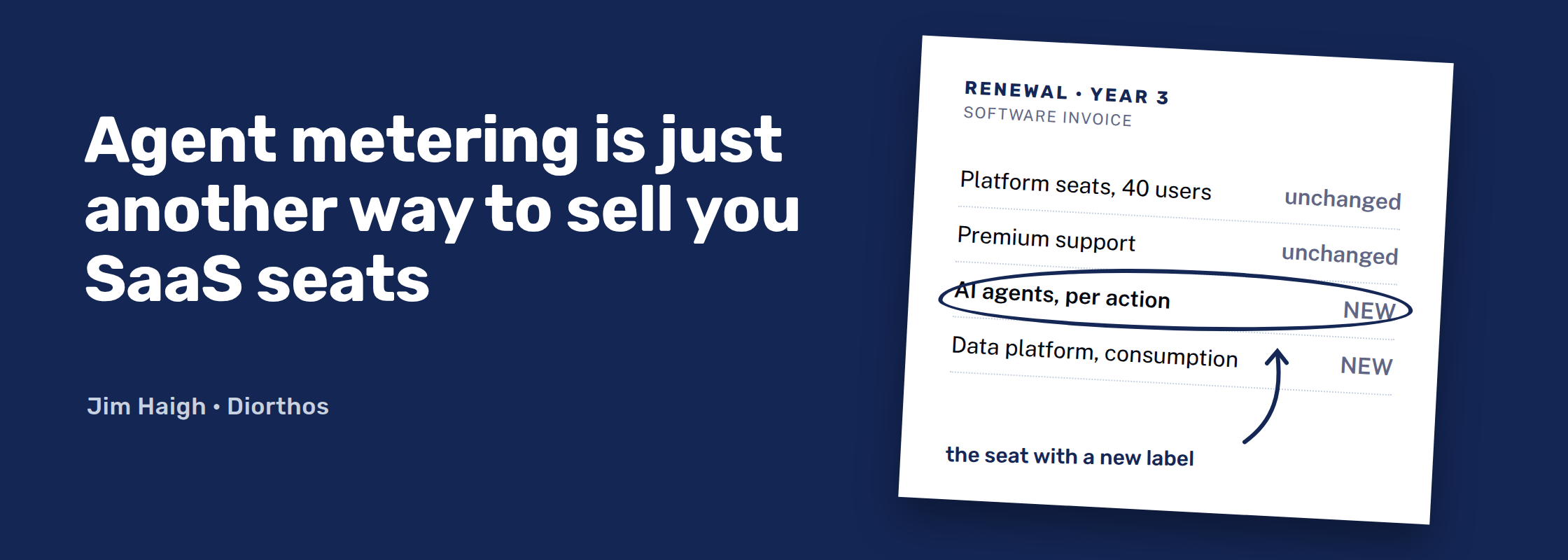
Now look at your renewal. The seats are still there, and under them is a new line for the agents. Per agent, per action. That line is the seat with a new label, and it exists because the vendor can't afford to lose the old one.
I sold the seat for a long time. I know what it's protecting.
The seat panic
The SaaS industry is terrified of losing seats. The more AI gets deployed, the fewer people a company needs. Per-seat pricing made sense for thirty years. Net revenue retention is built on it, and NRR is the number Wall Street values a software company on. Take the people out and the number breaks.
So they metered the agents. Not to price the agents. To make up the seats. They didn't swap the seat for the meter, either. They stacked it. Intercom: seats for the humans, plus $0.99 per resolution for the AI. Salesforce: per-user licenses, plus per-action credits, plus consumption fees on the data layer. Run the test on your own stack: if the AI price can never reduce the seat revenue, you're paying to protect their old model.
If you sell SaaS, your job is to land and expand. If no users need the software, how do you expand?
Five meters, all counting people
Here are all the ways the industry prices AI agents today.
- Per resolution. $0.49 to $2.00, and the vendor decides what "resolved" means.
- Per conversation. $0.40 to $2.00, resolved or not. One vendor cut its rate in half this year.
- Per action, sold as credits. A penny to a dollar a step. The same agent can cost $8 a month or $800 depending on how it's built.
- Per seat. $30 to $80 a month per human, on top of the licenses you already pay. Same price whether the AI handles a hundred conversations or ten thousand.
- Per "AI employee." $500 to $4,000 a month, custom above that. Annual contract. Message caps.
Each one is human labor accounting, with the human removed.
The margin problem
This one isn't greed. It's plumbing. For thirty years, software's marginal cost was rounded to zero; that's where 80-point gross margins came from. Most agent vendors resell model capacity, so every action their agent takes costs them real money per token. The meter passes that bill through to you, with margin on top, so the income statement keeps looking like a software company.
You are the buffer. The AI providers have cut their prices for two years running.
Do you honestly think a customer who just cut a seat is going to pay the same money for the agent that replaced it?
What the meter does to the customer
Under a meter, nothing is predictable. The more agents you throw at a problem, the more you pay, and nobody knows in January how hard the agents will need to work in June. So what does a company do with a cost it can't forecast? It caps it. Finance sets a budget, operations rations the agents, and the agents get told to do less than they could.
Nobody hires a salaried employee that way. You agree on a number, and you let them work. You'd never tell a good hire to stop in the third week of the month because the meter was running.
That's the cost of metering that never shows up on the invoice: the work the agents didn't do because you were afraid of the bill.
Pricing follows architecture
Seats worked because human attention was scarce. Agents don't have that problem. Their labor is close to free, and a meter charges you for the one input that costs nothing to make more of.
What's scarce is what the agents can see. An agent connected to your point of sale, payroll, bank feed, and inbox can run a back office. The same agent, with nothing to look at, will give solutions without context.
That's what we sell: AI labor for operators. Our agents connect to the systems a business already runs on, read them every day, and do the back-office work an owner used to do at night or pay somebody else to do.
We didn't have to make up lost seats with a meter. We don't carry the cost structure a SaaS company carries: no seat base to defend, no AI bill on our books. So we were free to price for the people we built this for.
Our customers are operators. Operators can't budget for variable AI labor, and they won't try. They have to know exactly what they're paying, or they don't buy. That's why we did this. The mission is AI labor that works, so operators can get back to doing what they love instead of paying for a meter nobody can predict. And if flat pricing holds at the bottom of the market, it holds anywhere.
A flat rate per connected data source. Everything the agents do with it is free. Your instance runs in the cloud, yours alone, at a flat fee that doesn't move either. You bring your own subscription, Gemini, OpenAI, or Anthropic, and pay your provider at their price with no markup. Put ten agents on a problem or one; our line doesn't move.
That puts the token bill on us to keep down, and we built it that way. Anything we can do mechanically, without a model, we do mechanically. A vendor that marks up tokens has no reason to work that way; every wasted call is revenue. A vendor whose customer holds the subscription has every reason. I don't see the industry building for that. Under a meter, why would they?
Why the incumbents won't follow
Because the price requires the architecture. A vendor that buys model calls and resells them can't offer a flat price; one heavy customer would cost more than it pays. Getting that bill off their books means the customer holds the subscription, which means giving up the markup, and the meter goes with it, and then there's nothing holding the seat stack up. Copying the price means dismantling the business.
They meter because they must.
Where this goes
Three things I'd bet on.
Per-resolution pricing dies in a billing dispute. When the seller decides what "resolved" means, every invoice is an argument waiting to happen. The first big customer that audits a quarter of resolutions and refuses to pay for the ones the bot didn't close will set the precedent, and every CFO who hears about it will ask for the same audit.
Credits get cheaper until nobody trusts them. One vendor already cut its rate in half this year. Every cut tells the buyer the last price was made up. By the time credits are cheap enough that people stop rationing them, the unit has no credibility left and the customers have learned to wait for the next cut.
The vendor that lets you hold your own AI subscription takes the account. Once a buyer sees a flat line next to a metered one for the same work, the meter never wins that comparison again. The incumbents will get there, but only after the metered revenue is gone, and by then so are the accounts.