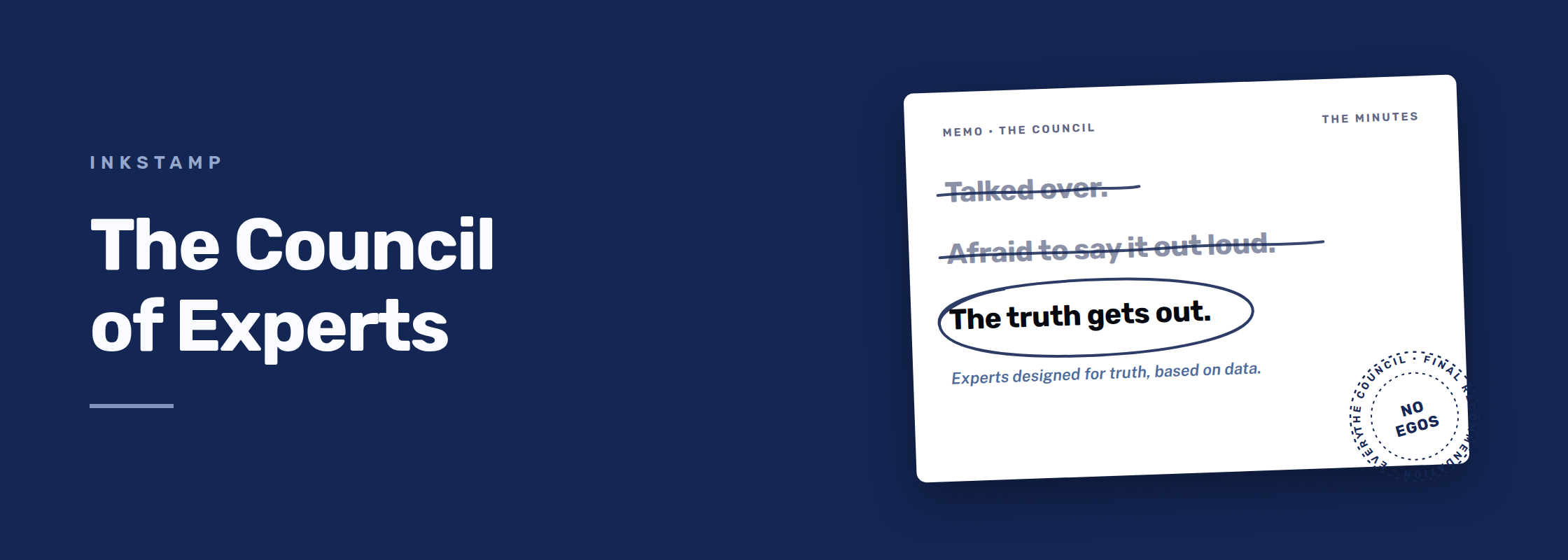

I spent years in executive meetings where the person with the right answer was in the room, and it didn't matter. Sometimes they got talked over. Sometimes they were afraid to say it out loud. I'd walk out shaking my head, wondering why truth was so hard to get out of a room full of executives, each an expert in their own world.
So we built you a room where nobody gets talked over and the best answer gets heard. A council of experts that reads all of your business data, and hands you an answer you can act on.
Think of the leadership team you'd hire if you could afford all of them at once. A CFO on the cash, a COO on the operation, a CMO on demand, and a strategist reading the whole picture. Each one fights for its own lens, grounded in what its discipline believes and backed by every number Inkstamp puts in front of it. The CFO won't soften the cash warning to keep the peace. The CMO won't shrink the growth case because the cash is nervous. They go at full strength, and none of them has an ego to bruise.
You ask it in plain words. Should I cut a shift? Why is money tight this month? It pulls your numbers, puts every expert on the question, and argues it out. Then it hands you one call, in plain English. You decide.
If you've run your business for a while, your gut is good. You've made these calls a thousand times, and most of the time you land them right. The council backs that instinct with your own numbers.
Four experts work in isolation
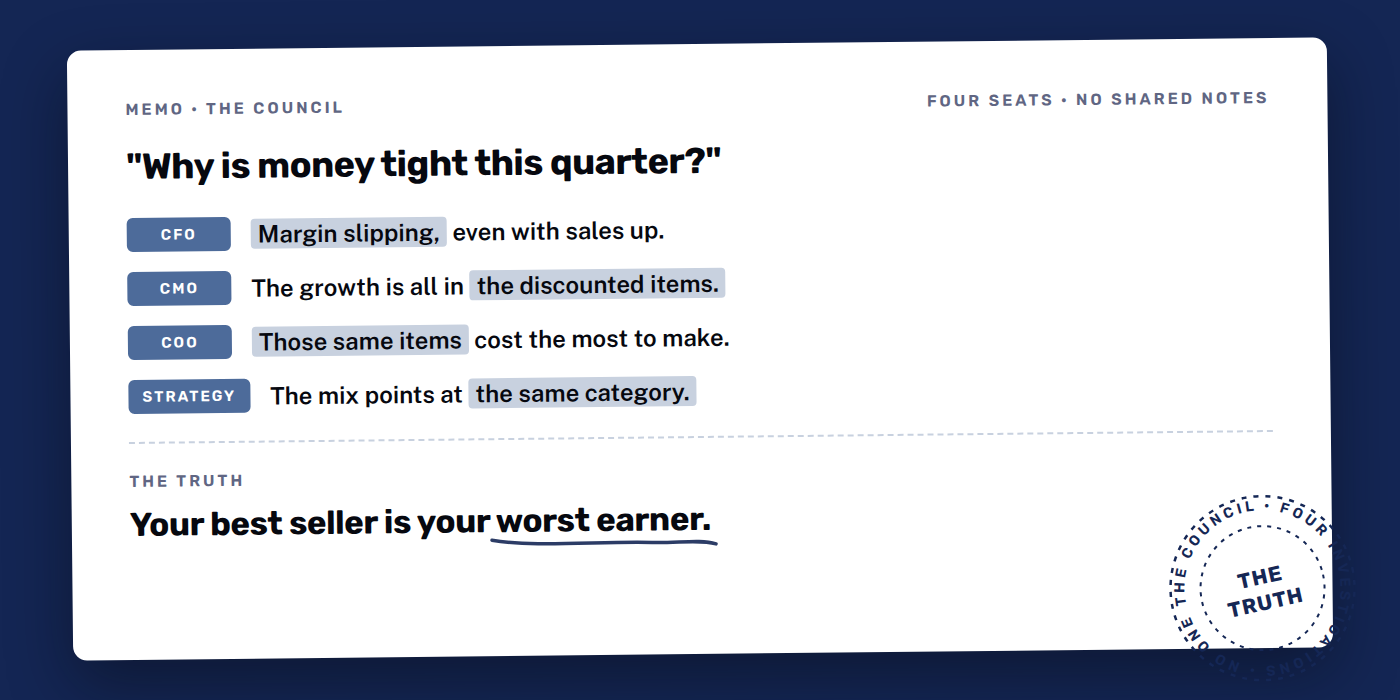
When you ask the council a question, it starts the way a real leadership team does. Before any expert says a word, it builds the brief from your actual books: every number pulled live and dated, with the estimates marked as estimates. That's the work a controller spends days doing before the leadership team sits down. Here it's done in minutes. Then the experts take the brief, each investigating on its own with no idea what the others are finding. The CFO traces the cash behind the totals. The COO tests whether the operation was staffed to the demand it actually had. The CMO reads which sales were bought with discounts and which came in on their own. The Strategist looks for the pattern across all of it.
Say the question is "why is money tight this quarter." The CFO comes back with margin slipping even though sales are up. The CMO, working separately, finds the growth is all in the discounted items. The COO shows those same items cost the most to make. And the Strategist, reading the product mix, lands on the same category. Four separate investigations, one answer: your best seller is your worst earner. It means something because no one coordinated it.
Much better than prompting
Becoming a great CFO takes years and a shelf of books you'll never have time to read. We took that knowledge, what it actually takes to be a top one, and trained the expert to use it on your numbers. Same for the COO, the CMO, and the strategist.
What we learned building it
We had to overcome some AI tendencies. Push it hard enough and it caves and hands you the answer you came for. These experts don't. Tell the CFO you're sure you're in growth mode, and it won't bend to make you happy. Its read stands until your numbers say otherwise.
Left to themselves, a council of experts does exactly what a real leadership team does. It reaches for the safest answer in the room, and nine times out of ten that's the CFO's. It didn't matter whether sales had the better case or the CMO did. The cautious number carried the call, and everyone learned to stop fighting it.
The conservative answer isn't wrong. It just shouldn't win by default. A growing business pays for that caution in the growth it never gets. So we built the weighting the room never had. It follows the business, not the most cautious voice in it.
That weighting is the Chairman's job. It reads what your business needs right now and decides whose lens rules the room. When cash is tight the CFO leads. When the question is growth the strategist carries more weight. The council has no CEO seat. That chair is yours.
See it in action
The council argues the options in front of you, then hands you a single call, with your own numbers showing why. It also gives you the trigger: the number that tells you when the call is going wrong, and what to do instead.
Say you run an HVAC shop and ask: calls are down 15% this shoulder season, should I cut a tech or push renewals? Here's what comes back:
THE COUNCIL'S VIEWS
COO: Pull the hours back to match the season. You can't keep eight techs busy at this call volume. Driven by: billable ran 61% last month, down from 74% in June.
CFO: Cut the tech. A cut is certain savings; renewals are maybe-money. Driven by: cash covers 95 days, and payroll is the biggest line.
CMO (lead): Keep the tech and work the renewal list. Every lapsed agreement is a customer somebody else wins the next time the weather hits. Driven by: 51 maintenance agreements worth about $9,700 lapse in the next month, and 14 of those owners haven't gotten a call.
STRATEGY: Hold the recurring base through the season. The real question isn't the tech. Driven by: the calls come back with the weather. Lapsed agreements don't.
The Chairman: Based on the council's views, here is my recommendation.
THE CALL
Keep the tech. Work the 51 renewals, starting with the 14 who never got a call, and give it two weeks.
WHY THIS, NOT THAT
With 40 days of cash, the COO and CFO would be right. At 95, certainty doesn't get to rule, and the Strategist has the real question: whether the recurring base holds through the season.
The tech you'd cut is the one who runs those 51 tune-ups. The renewal push fills his schedule, and a tech let go in October isn't there when the weather turns.
Given up: $50 off a fall tune-up for the 14, about $700, and two weeks of one tech's pay you might have saved, call it $3,000.
DO THIS WEEK
Call the 14 who never got a renewal call and offer $50 off a fall tune-up. Book each renewal into a fall slot on the same call; that fills the tech's schedule. Count renewals every Monday.
THE TRIGGER
If fewer than 20 of the 51 have renewed or booked a fall tune-up by the second Monday, cut the tech's hours and trim the fall schedule. The second Monday is decision day.
That's the whole answer, about ninety seconds to read. Four seats argued: two wanted to pull back, one wanted to push, one changed the question. The Chairman ruled with the reasoning shown. It isn't a vote. You see every lens, and you watch one number.
Every line of it traces back to a number in your own books. That's the standard the council is held to: a claim that can't show its number doesn't go in.
The council argues. You decide.
Think back to those meetings, and the person with the right answer nobody heard. That's what we set out to fix. Here, every seat makes its hardest case, and the truth gets out. Then the council hands you the call with the reasoning under it. The decision is yours. It always was.